
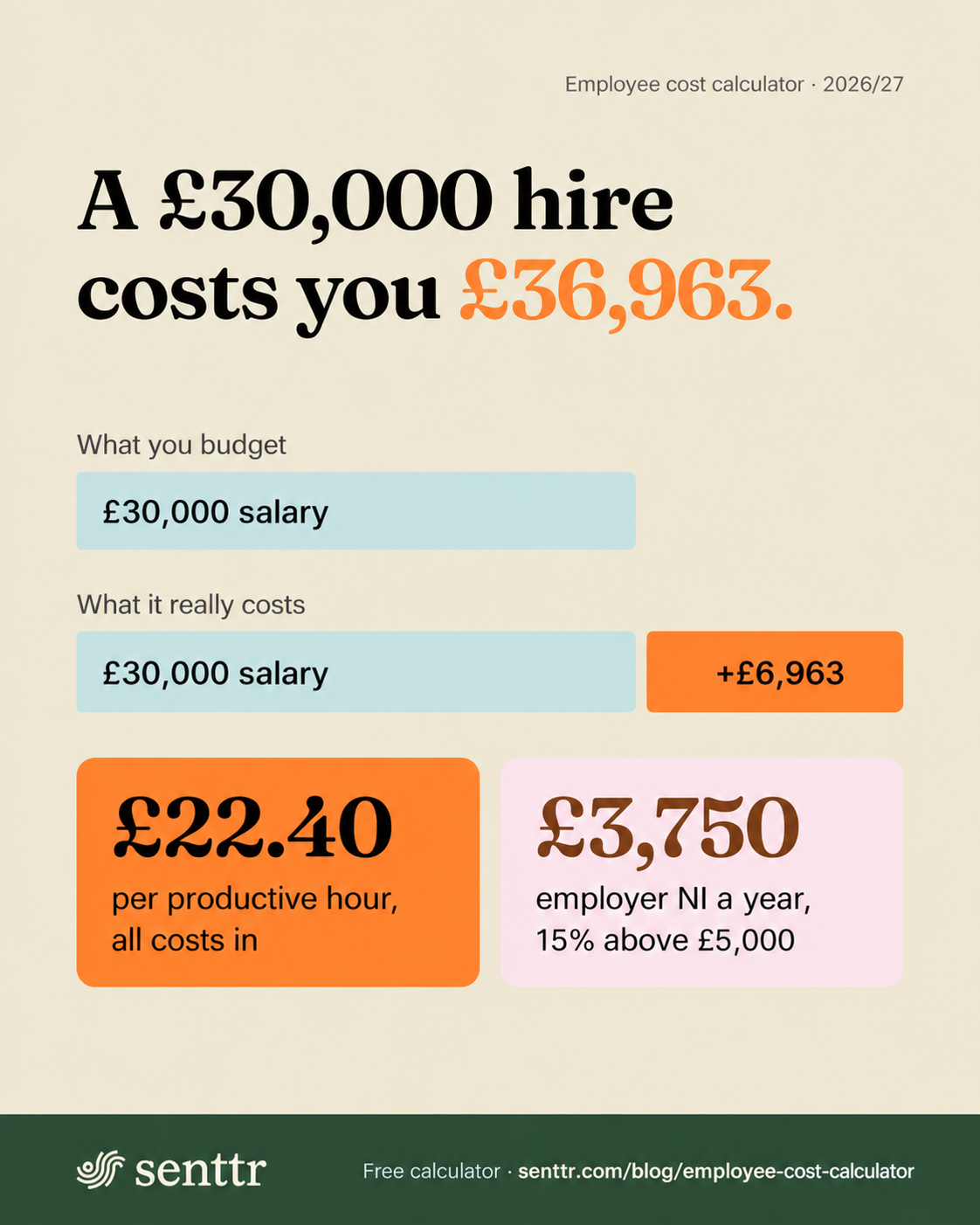
Ask most business owners what a member of staff costs and they will give you the salary. Ask what that person costs per hour, once employer National Insurance, pension and everything else is counted, and the room goes quiet. In one 2026 survey of UK small business owners, 83% had never once calculated what the time their people spend on admin was costing the business.
It matters more than it used to. Since April 2025, employer National Insurance has been charged at 15%, up from 13.8%, and it now starts at £5,000 a year instead of £9,100. Employing someone in the UK costs noticeably more than it did two years ago, and the salary line hides most of the increase.
Use the calculator below to get the real number for any role, then read on for how each line is worked out.
True annual cost
That is 23% on top of the salary.
- Gross salary£30,000
- Employer National Insurance£3,750
- Employer pension£713
- Other costs£2,500
- Total a year£36,963
Side by side
Your employee next to a digital worker
| Your employee | Digital worker | |
|---|---|---|
| Salary or monthly fee | £30,000 | £7,200 |
| Employer NI | £3,750 | £0 |
| Pension | £713 | £0 |
| Laptop, desk, recruitment | £2,500 | £0 |
| Total a year | £36,963 | £7,200 |
Cost per hour
24/7 It works every hour of the year, nights, weekends and bank holidays included. Spread over all 8,760 hours, that is £0.82 an hour.
No NI, no pension, no desk and no recruiter. At this person’s hourly cost a digital worker pays for itself once it takes 6.7 hours a week of repetitive work off the team.
Uses 2026/27 rates: employer NI at 15% above £5,000 a year, and pension on earnings between £6,240 and £50,270. Ignores the Employment Allowance, which reduces your total NI bill but not the cost of the next hire once used up. A guide, not tax advice.
What goes into the true cost of an employee
There are four parts to it. Two are set by law, and two depend on how you run your business.
1. Employer National Insurance
For the 2026/27 tax year, employers pay Class 1 secondary National Insurance at 15% on everything an employee earns above £5,000 a year (the secondary threshold, or £417 a month). There is no upper limit for employers.
On a £30,000 salary the sum is simple:
£30,000 minus £5,000 = £25,000
£25,000 × 15% = £3,750 a year
There are two exceptions worth knowing. You pay no employer NI on employees under 21, or on apprentices under 25, until their earnings pass £50,270 a year. Tick the box in the calculator to see the difference.
2. Employer pension contributions
Under auto-enrolment, employers must pay at least 3% of an employee's qualifying earnings. For 2026/27, qualifying earnings are the slice of pay between £6,240 and £50,270 a year. Anyone earning over £10,000 must be enrolled automatically.
On £30,000, that works out as:
£30,000 minus £6,240 = £23,760
£23,760 × 3% = £713 a year
Many employers pay more than the minimum, or calculate it on full salary. If you do, change the percentage in the calculator.
3. The costs that never appear on a payslip
This is where most estimates go wrong. A person needs a laptop, a phone, software licences, a desk, and somewhere to sit it. Before any of that, they need to be found, which usually means a recruiter's fee or a job board and someone's time spent interviewing.
Spread across a few years, these typically add £2,000 to £5,000 a year per head for an office-based role. The calculator uses £2,500 as a conservative default. It does not try to count management time, holiday cover or the months it takes a new starter to get up to speed, all of which are real but harder to price.
4. Productive hours, which turn a yearly cost into an hourly one
A full-time employee on 37.5 hours a week is paid for about 1,950 hours a year. They are not available for all of them. Take off 28 days of statutory holiday, average sickness, training and the general non-productive time every job has, and you are left with around 1,650 productive hours.
Divide the annual cost by productive hours, not paid hours. That is the honest price of an hour of someone's time.
A worked example: one coordinator on £30,000
| Cost | Per year |
|---|---|
| Gross salary | £30,000 |
| Employer NI at 15% above £5,000 | £3,750 |
| Employer pension at 3% above £6,240 | £713 |
| Equipment, software, workspace and recruitment | £2,500 |
| Total cost to the business | £36,963 |
| Productive hours a year | 1,650 |
| Cost per productive hour | £22.40 |
A £30,000 coordinator costs you nearly £37,000 a year, or 23% more than the salary. Every hour of their time costs £22.40.
What about the Employment Allowance?
Eligible employers can claim the Employment Allowance, which takes £10,500 a year off their total employer NI bill. Since April 2025 it is open to more businesses, because the old rule excluding employers with an NI bill over £100,000 has gone. Companies whose only employee is a director still cannot claim it.
It is worth claiming, but it does not change the sums above as much as it seems. The allowance is a single amount for the whole business, not per employee. Once it has been used up across your existing team, every new hire costs the full 15%. That is why the calculator leaves it out: it shows the cost of the next person, not the average.
Why the hourly number is the useful one
The annual figure tells you what a hire costs. The hourly figure tells you what each task costs, and that is where it gets uncomfortable.
UK workers report spending 31% of the working week on non-core admin, the highest share in Europe. On a 37.5 hour week that is 11.6 hours. At £22.40 an hour, that is about £12,000 a year per person spent on re-keying orders, chasing timesheets, building the same quote pack again and sending invoice reminders. Across a back office of five, it is close to £60,000.
None of that work is why you hired them. It is the second job that comes with the first.
Where a digital worker fits in
The calculator's last line compares your number with a Senttr digital worker, which costs £600 a month, or £7,200 a year. Against the £30,000 coordinator above, that is 19% of the cost.
It is not a replacement for that person, and we would not pitch it as one. Skilled people in UK industry are hard to find and harder to keep. A digital worker takes on one repetitive process end to end, such as invoice chasing, quoting or timesheets, and gives those hours back to your team.
At £22.40 an hour it breaks even once it returns 6.7 hours a week. That is less than one working day, and below the 11.6 hours the average UK worker loses to admin.
"But my people do lots of different jobs"
They do, and it is worth thinking through. A coordinator answers the phone, books jobs, chases invoices, sorts timesheets and a dozen other things. A digital worker does one job. So would you need several to match one person?
You might, but that is the wrong comparison. The point is not to swap a person for software. It is to take specific tasks off the team. So judge a digital worker against a task, not a person, and add up that task's hours across everyone who touches it.
Invoice chasing might take three hours a week from each of three people. Timesheets might take ten hours each from two. No single person's week justifies a digital worker, but each of those tasks clears the 6.7 hour bar comfortably.
And if you do end up with several, the sums still work. Three digital workers cost £21,600 a year, 58% of one £30,000 coordinator. Five cost £36,000, about the same as that single hire, and each one only has to clear its own break-even.
Small tasks are the exception. If something takes two hours a week across the whole business, a digital worker will not pay for itself on hours alone. It needs another reason, such as faster quotes winning more work or steady chasing bringing cash in sooner. That is why the best place to start is the task that eats the most hours and sits closest to cash.
The short version: if a task takes more than a day a week across your team, it is worth handing over.
Want the full arithmetic? Our white paper, The extra pair of hands your operational team has always needed, works through three costed examples, what the money looks like month by month, and how to run a 90-day pilot that proves it in your own numbers. Get the free white paper.
Frequently asked questions
How much employer National Insurance do I pay on a £30,000 salary?
£3,750 a year in 2026/27. Employers pay 15% on earnings above £5,000, so the calculation is (£30,000 − £5,000) × 15%.
What is the employer National Insurance threshold for 2026/27?
The secondary threshold is £5,000 a year, £417 a month or £96 a week. Employers pay 15% on earnings above it. Both the rate and the threshold are unchanged from 2025/26.
Do employers pay National Insurance for employees under 21?
Not on earnings up to £50,270 a year. The same relief applies to apprentices under 25. Above £50,270 the normal 15% applies.
What is the minimum employer pension contribution?
3% of qualifying earnings, which for 2026/27 is pay between £6,240 and £50,270 a year. The employee pays a further 5%, making 8% in total.
How many productive hours does a full-time employee work in a year?
Around 1,650 for a 37.5 hour week, once holiday, sickness, training and non-productive time are taken off roughly 1,950 paid hours. It varies by role and business, so you can change it in the calculator.
Does the Employment Allowance reduce the cost of a new hire?
Only until it runs out. The £10,500 allowance comes off your whole business's NI bill once a year. When it has been used up across your existing staff, each new hire costs the full 15% employer NI.
My staff do many different jobs. Would I need several digital workers to replace one person?
You would not be replacing anyone. A digital worker takes one task off the team, so compare it with the hours that task takes across everyone who does it. At £22.40 an hour it pays for itself above about 6.7 hours a week. Even five digital workers, at £36,000 a year, cost about the same as one £30,000 coordinator.
Rates and thresholds from HMRC rates and thresholds for employers 2026/27 and the DWP review of auto-enrolment thresholds for 2026/27. This page is a guide, not tax or payroll advice.