
At any one time, around £26 billion is owed to UK businesses in late payments. That is not bad debt or disputed work. It is money for jobs that were done, delivered and invoiced, sitting in somebody else's bank account.
If you run a construction, manufacturing or distribution business, you do not need a statistic to tell you this. You feel it every month when the work is booked, the wages are paid and the cash still has not arrived. This article puts numbers on what that is costing you, sets out the rights you already have, and explains what the new Commercial Payments Bill will change.
How big the UK late payment problem is
Analysis by the Department for Business and Trade and the Office of the Small Business Commissioner puts the scale like this:
£26 billion owed to UK businesses in late payments at any given time
around £17,000 on average for each business affected
1.5 million businesses, or 28% of all UK firms, hit by late payment in a given year
close to £11 billion a year in total cost to the economy, once lost time, financing costs and business failures are counted
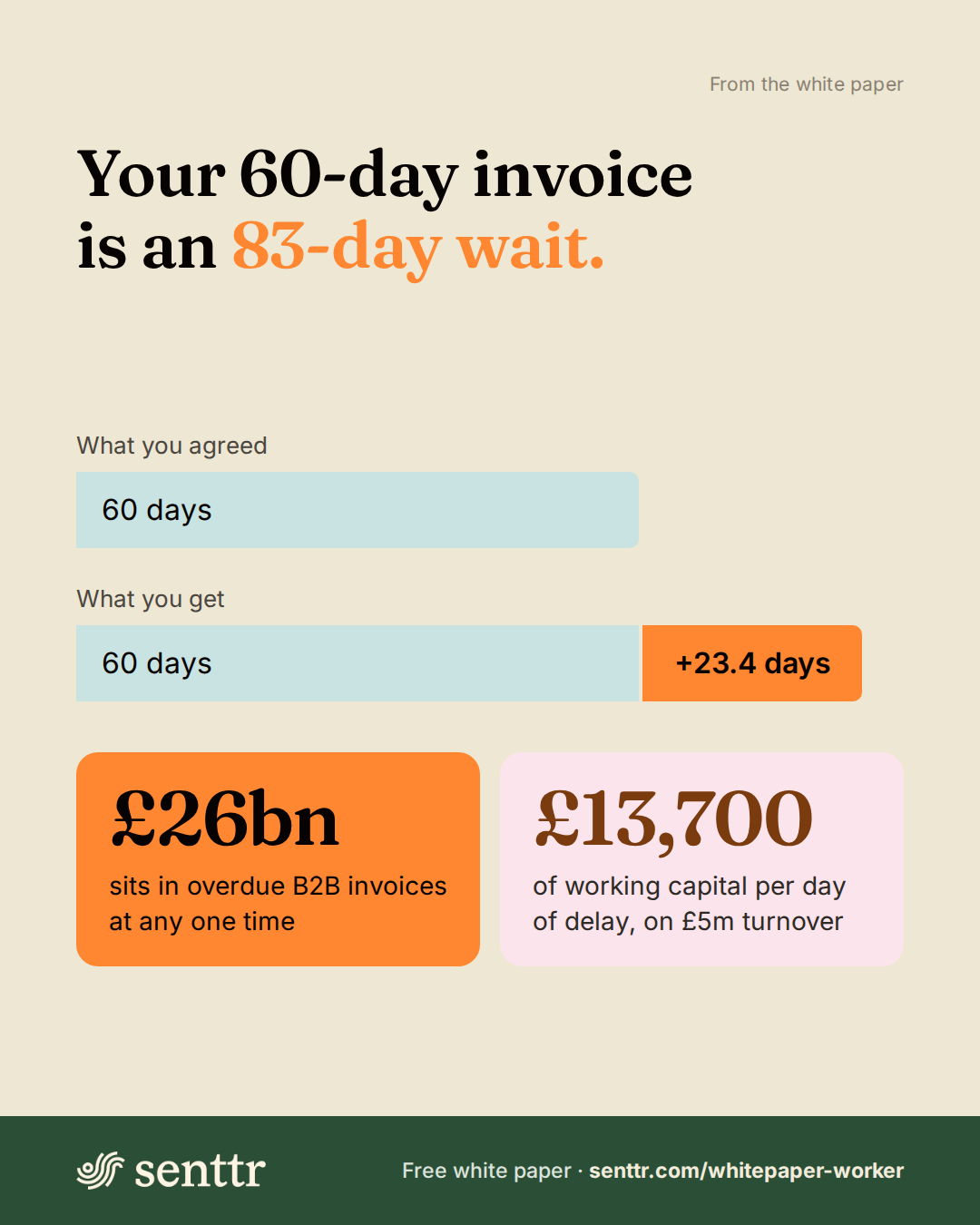
Evidence given to Parliament puts 44% of SME invoices as paid late. And when invoices are late, they are very late: the average UK invoice is paid 23.4 days beyond the agreed terms. A 60 day invoice becomes an 83 day wait.
Why construction feels it most
Construction has the worst payment record of any major UK sector, and it shows in the insolvency figures. In the twelve months to July 2026 there were 3,841 construction insolvencies in England and Wales, 17% of all cases where an industry was recorded and more than any other sector.
Most of those businesses were not unprofitable. Insolvency is usually a cash event rather than a profit one: the work is priced right and the margin is there, but the money arrives after the wages, the materials and the VAT bill have gone out. Long supply chains make it worse, because every late payment at the top is passed down to the subcontractors and suppliers below.
What a late invoice actually costs you
Late payment is easy to shrug off as an inconvenience. It is easier to take seriously once it has a price.
Take a business turning over £5 million a year. Each day of sales is worth about £13,700. If customers pay that business an average of 23.4 days late, about £320,000 of its own money is sitting outside the business at any one time.
That money has a cost. If you fund the gap with an overdraft, invoice finance or simply by not investing, and you value it at 8%, those 23.4 days cost around £25,600 a year. That is before you count bad debts, the time spent chasing, or the work you turned down because cash was tight.
Then there is the hidden cost: the hours. Someone in your business is checking the ledger, writing reminder emails and making awkward phone calls every week. In most firms nobody has ever added up how many hours that takes.
The rights you already have
Many businesses do not realise how strong their position already is. Under the Late Payment of Commercial Debts (Interest) Act 1998, on business-to-business invoices you can claim:
Statutory interest at 8% above the Bank of England base rate. The base rate that counts is the one in force on 30 June (for debts that fall due from July to December) or 31 December (for January to June). With the base rate at 3.75%, that is 11.75% a year on the overdue amount.
Fixed compensation for each late invoice, on top of the interest:
| Invoice value | Fixed compensation |
|---|---|
| Up to £999.99 | £40 |
| £1,000 to £9,999.99 | £70 |
| £10,000 or more | £100 |
Reasonable recovery costs above those fixed sums, if chasing the debt cost you more.
If no payment date was agreed, payment is due 30 days after the invoice or the delivery, whichever is later. Agreed terms between businesses can run to 60 days, and longer only if they are expressly agreed and not grossly unfair to the supplier.
So why does almost nobody claim? Because it feels like picking a fight with a customer you want to keep. That is exactly the gap the new law is trying to close.
What the Commercial Payments Bill will change
The Commercial Payments Bill was introduced in the House of Lords on 19 May 2026. Its main measures are:
A 60 day cap on payment terms between businesses, and 30 days where the buyer is a public authority. Longer terms in a contract would be void, and buyers could not get round the cap by delaying the date the clock starts.
Mandatory statutory interest. The 8% above base rate would become an implied term that contracts cannot exclude or water down.
A ban on retentions in construction contracts, after a two year transition period.
New powers for the Small Business Commissioner, including a binding adjudication scheme that only the smaller business can trigger, and fines of up to 1% of UK turnover for persistent late payers.
Tougher reporting for large companies, including the interest they owed and actually paid, and board-level commentary where payment performance is poor.
When will it apply? Not yet. The Bill is still going through Parliament. The Small Business Commissioner hopes for Royal Assent in early 2027, after which secondary legislation is needed, so the payment cap is not expected before 2027 at the earliest.
What happened to the Prompt Payment Code?
The Prompt Payment Code was replaced in February 2025 by the Fair Payment Code, run by the Office of the Small Business Commissioner. It has three tiers, and each requires at least 95% of invoices to be paid on time:
Gold: all invoices paid within 30 days
Silver: all invoices within 60 days, and small business invoices within 30
Bronze: all invoices within 60 days
It is voluntary, but it is useful. Before you take on a large new customer, check whether they hold an award, and look up their published payment practices on GOV.UK. Large companies have to report how quickly they pay.
What actually gets you paid
Better law will help, but it will not collect a single invoice for you. What does is boring and reliable: chasing every invoice on a fixed schedule, every time, without exceptions.
Sage tracked small businesses that moved from ad-hoc chasing to a fixed routine and found a 27% average fall in debtor days within 90 days. Most chasing failures are not about effort or nerve. They happen because chasing is the job that slips when everything else is urgent. We have set out the routine step by step in our guide to credit control.
It is also the kind of work a digital worker does well. It sends the reminder on the day it is due, follows up the day after, and flags the accounts that need a person to pick up the phone. It does that for every invoice, every day, without forgetting.
Want to see the full numbers? Our white paper, The extra pair of hands your operational team has always needed, models what a fixed chasing routine releases for a £5 million business, alongside quoting and timesheets, and how to prove it in 90 days. Get the free white paper.
Frequently asked questions
How much is owed to UK businesses in unpaid invoices?
Around £26 billion at any one time, according to the Department for Business and Trade and the Office of the Small Business Commissioner. That averages about £17,000 for each affected business, and around 1.5 million businesses are affected each year.
What interest can I charge on a late invoice in the UK?
Statutory interest of 8% above the Bank of England base rate, under the Late Payment of Commercial Debts (Interest) Act 1998. With the base rate at 3.75%, that is 11.75% a year. You can also claim fixed compensation of £40, £70 or £100 per invoice, depending on its value.
How long does a business have to pay an invoice?
If no date was agreed, 30 days from the invoice or delivery, whichever is later. Agreed terms between businesses are usually up to 60 days. Public authorities must pay within 30 days.
What is the Commercial Payments Bill?
A bill introduced in May 2026 that would cap business payment terms at 60 days, make statutory late payment interest compulsory, ban construction retentions after a transition period, and give the Small Business Commissioner powers to adjudicate disputes and fine persistent late payers.
When does the Commercial Payments Bill come into force?
It is still going through Parliament. Royal Assent is hoped for in early 2027, and the main measures need secondary legislation after that, so they are not expected to apply before 2027 at the earliest.
What replaced the Prompt Payment Code?
The Fair Payment Code, launched in February 2025 by the Office of the Small Business Commissioner. It awards Gold, Silver or Bronze status depending on how quickly a business pays its suppliers.
Figures from the Department for Business and Trade with the Office of the Small Business Commissioner (July 2025), evidence cited in Parliament on the Commercial Payments Bill, Insolvency Service data for England and Wales to July 2026, Sage (2023), and the Bank of England (Bank Rate as at September 2026). This page is a guide, not legal advice.