
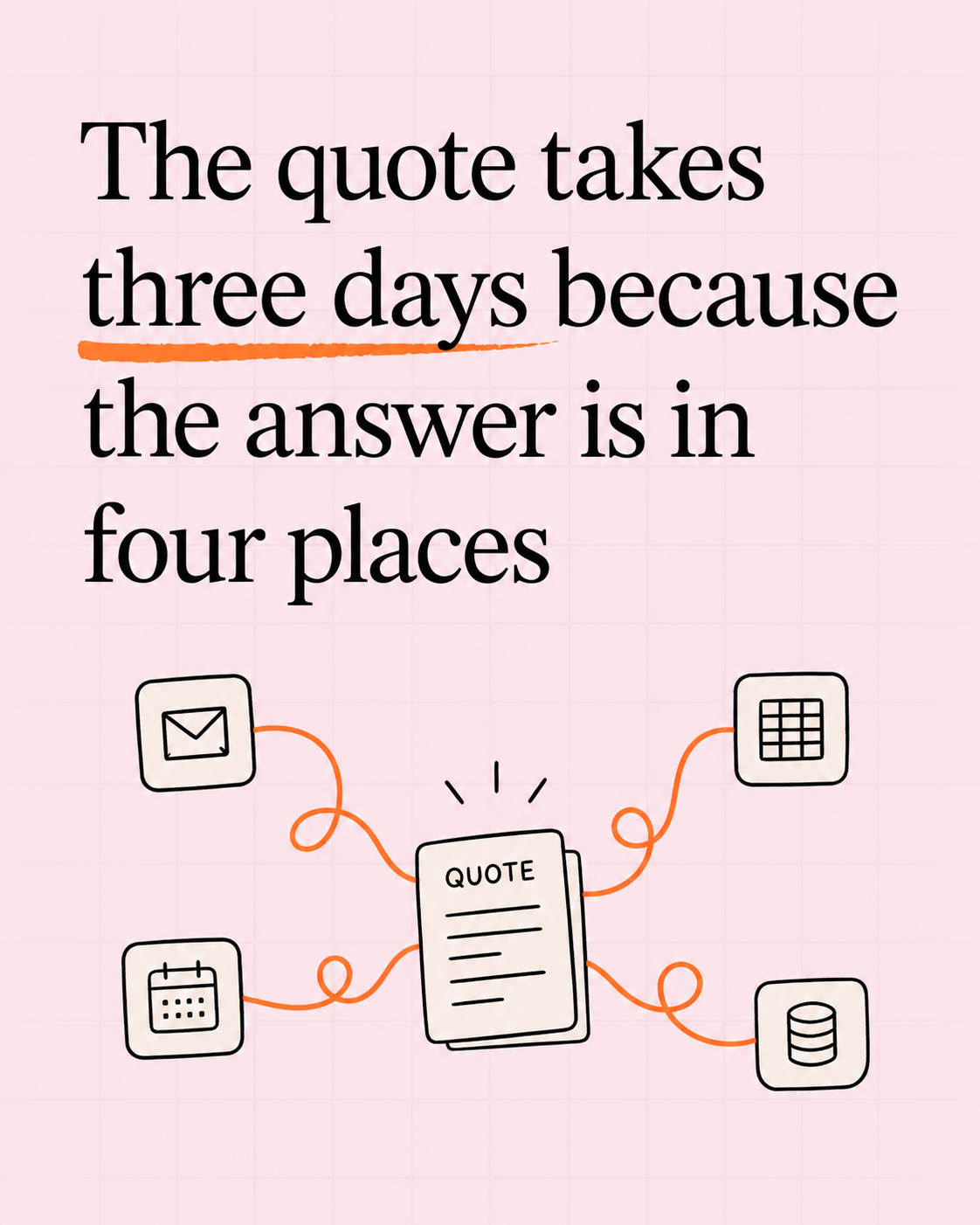
An enquiry arrives on Monday. The quote goes out on Thursday. Ask the people involved where the three days went and they will say pricing, because that is the part that feels like the job.
It is rarely where the time goes.
The skilled part of a quote, the judgement about margin, risk and whether to bid at all, takes a fraction of the time. Most of the rest goes on something less visible: taking a request written in the customer’s words and their layout, and turning it, line by line, into your own terms. Your product codes, your sizes, your options, your rules. Only once that translation is done can anyone price anything.
That translation is what digital workers take off the desk.
The request is never in your terms
Customers do not write enquiries for your convenience. They write them in whatever form they have to hand.
For a manufacturer of made-to-order products, that might be a schedule attached as a PDF, a spreadsheet, a scanned drawing, a few lines in the body of an email, or a list of quantities with no detail at all. Items are often grouped into types rather than listed one by one. Measurements may describe the space the product has to fit rather than the product itself, and the two are easy to confuse. Options are written as free text, ticked in a column, or left out entirely.
For a distributor of stocked products, the request is usually an order or a request for a price. It might arrive as a PDF, a spreadsheet, text typed into an email, or the customer’s own order form, sometimes with several orders in one message. Lines describe products in the customer’s language rather than the catalogue’s. Part numbers belong to the customer or to another supplier. Sizes come in different units and different orders, and quantities go missing.
None of this means the team is slow. It means the front office receives requests written in a language the business does not use internally, and every one has to be translated by hand before anything else can happen.
Two kinds of quoting
It is tempting to treat all quoting as one problem. It is really two, and the difference matters when you are deciding what to automate.
The first is configure to quote. When every product is made to order, each item needs a full specification built from scratch: a size the factory can actually make, the right technical rating, and only the options that product range allows. The hard part is rules and arithmetic, and the quote is where nearly all the work sits.
The second is match to quote. When nearly every line is a stocked item, the work is finding the right product from a loose description, among thousands of near look-alikes, and working out quantities. Here a quote and an order are almost the same job, which is why the work done to answer the enquiry can carry straight through to the order. That is the idea behind quote to order: do the matching once, and use it twice.
Most quoting software is built for one of these and sold as though it covers both.
What digital workers do with a request
The digital worker receives the enquiry in its own inbox. It reads every attachment, including scans and drawings, and lists every item on its own line, even where the customer grouped them. What the customer wrote is kept separate from anything the digital worker works out, so nobody has to wonder which is which.
From there, the work depends on which kind of quoting it is.
In a configure-to-quote business, the digital worker places each item in the right product range, works out a size the business can actually manufacture, and picks each option only from the values the business’s own quoting template accepts. Where the request is silent, it applies the business’s own default rules, and anything the customer did state always wins over a default. It builds the business’s own quoting spreadsheet and sends it to the estimator with a short summary and a list of anything that needs checking. If something essential is missing and cannot safely be assumed, it asks the estimator for exactly that and carries on when they reply.
In a match-to-quote business, it finds the customer’s account, reads each line, and matches it to the right item, starting with what that customer has bought before. It checks stock, works out what a cut list needs, and prepares the order or quotation in the business’s own system, with every line it is less certain about clearly marked for review.
For one of our customers, a manufacturer of door systems, quotes that used to take one to three days from enquiry to sending now go out the same day.
A person always signs off
Digital workers do the reading, typing and looking up. The judgement stays with the business.
How far the automation goes is the customer’s decision. Some businesses want the digital worker to stop at a prepared draft. Others want it to carry the work further, all the way into their own systems. Either way, there is a human-in-the-loop step built in, so a member of staff reviews and approves before a quote is sent out or an order is triggered.
That review is made easy rather than left to chance. Anything the digital worker is less sure about is flagged, and anything the customer did not specify comes back marked as missing rather than filled with a guess. A tool that fills gaps with plausible-looking assumptions has only created work for later. The estimator stays in charge of the price, the margin and the conversation with the customer.
This is the same line we draw everywhere, separating the mechanical steps from the decisions.
Built around your business, and better with use
Every business quotes differently, so we work with each customer to configure their digital workers around their own rules, products, templates and systems. The defaults it applies, the sizes it works to and the options it chooses from are the business’s own, not a generic set.
Digital workers also become smarter over time. The more orders and enquiries they see, the better they get at reading that business’s customers and matching their requests, with improvements reviewed before they go live.
And the data stays with the business. Senttr never passes customer data to a public model for training.
The test worth applying
When a supplier demonstrates quoting software, give it one of your own real enquiries. Not a clean sample. A forwarded email chain with a scanned schedule, items grouped into types, measurements you have to interpret, and half the options missing. Or an order with the customer’s own part numbers, mixed units and a line that says “same as last time”.
Then look at two things: what comes back, and what it did with the parts it could not know. One that hands back everything it could work out, in your terms, with the doubts clearly marked, has done the part that was taking three days.
If you want the buyer’s side of why that speed matters, the write-up of one manufacturer’s quote process covers what happens to a customer while a slower quote is still being assembled. Where the request is a formal bid rather than a commercial enquiry, the problem looks more like responding to a formal tender.
Quoting is one of the first jobs businesses hand to digital workers. Not because quoting is simple, but because so much of it was never quoting at all.
Frequently asked questions
What is quoting software?
Quoting software helps produce a priced quotation for a customer. Some tools only format and send a quote from numbers you already have. Others handle the work before pricing: reading the customer’s request, turning it into your own products, sizes and options, and preparing it for an estimator to price.
Why do quotes take so long to produce?
Usually because the request arrives in the customer’s terms rather than yours. Items are grouped, measurements need interpreting, options are missing, and products are described in the customer’s language rather than your catalogue’s. Translating each line into your own products and options takes far longer than the pricing decision that follows it.
What is the difference between configure to quote and match to quote?
Configure to quote applies to made-to-order products, where each item needs a full specification built from rules before it can be priced. Match to quote applies to stocked products, where the work is matching each line to the right catalogue item, and the same matching serves both the quote and the eventual order.
Can quoting be automated?
The preparation can: reading the enquiry and attachments, listing every item, applying your rules where the request is silent, matching to your products, and building your own quoting sheet or order with uncertain lines flagged. How far the automation goes is your decision, with a person reviewing and approving before anything is sent or triggered.
Do digital workers send quotes to customers?
Only as far as the business chooses. Senttr’s digital workers can be set up to stop at a prepared draft or to carry the work further into the business’s own systems, and in every case a member of staff signs off before a quote is sent out or an order is triggered.
How is it set up?
Senttr works with each business to configure its digital workers around that business’s own rules, products and systems. They work alongside the systems already in use rather than replacing them, and they improve the more requests they see.