
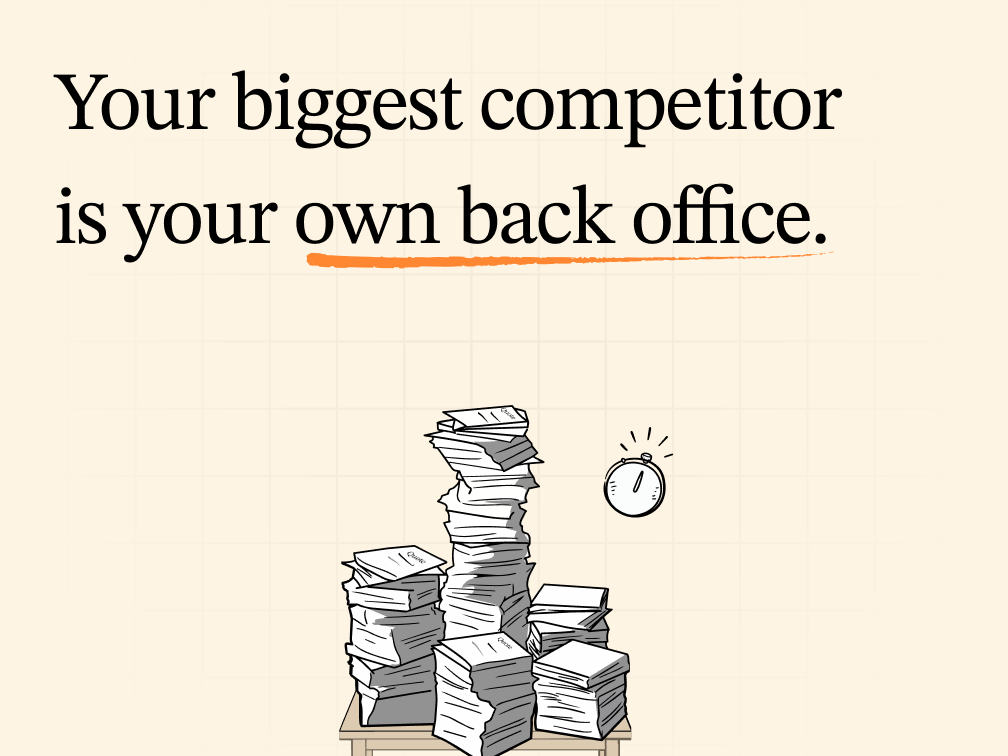
Most businesses spend a lot of time thinking about their competition. What competitors are charging. What they are offering. How to position against them. It is a reasonable thing to focus on.
But there is a competitor most commercial directors and MDs never think about, and it is almost certainly costing more in lost revenue than any rival ever has.
It is your own back office.
Speed wins more deals than you think
This tends to make people uncomfortable when they first hear it: in B2B sales, how quickly you respond to an inquiry often matters more than what you are selling or what you are charging.
When a buyer reaches out for a quote, they are never talking to just one supplier. They are reaching out to two or three at least, and the first business to come back with a credible answer has a significant advantage. Not because they are better. Not because they are cheaper. Simply because they were there first.
This is especially true in industries where buyers are moving fast. Construction projects running to deadlines. Manufacturing lines that need to keep moving. Engineering firms waiting on a quote before they can commit to a client. In these environments, a slow response does not just feel frustrating. It actively pushes buyers towards whoever gets back to them first.
Think about the last time you were the buyer
Think about the last time you needed something quickly and reached out to more than one supplier. If one came back within the hour and another took two days, how often did you wait for the slower one?
Most people do not wait. They go with whoever showed up. And if the slower supplier eventually comes back with a better price or a slightly stronger offer, it often does not matter. The decision has already been made.
Your customers are doing exactly the same thing.
What your response time says about you
How quickly you come back with a quote tells a buyer something about more than just your quoting process. It tells them what working with you will feel like.
A business that responds within hours signals that it is organised and takes enquiries seriously. A business that takes three days signals the opposite, even if unintentionally.
Buyers are making a judgement about you before you have even won the job. In industries where delays carry real cost, nobody wants a supplier that is slow when things are straightforward. It raises an obvious question about what they will be like when things get complicated.
And it is only getting harder
Buyer expectations around response time have shifted, and they are not shifting back.
Customers who would have accepted a two or three day wait five years ago now expect something by end of day. That expectation has carried over from how they buy in other parts of their lives, and it is not going away.
Doing nothing is not a neutral position. Standing still on response times while expectations continue to move means falling further behind, quietly and consistently, without any single moment where it becomes obvious.
The uncomfortable question
So here is the question worth asking yourself: how much revenue is my business losing not to a competitor, but to my own back office?
Not because your sales team is not good enough. Not because your product is not competitive. But because by the time a quote gets assembled, checked, approved, and sent, the customer has already heard back from someone else and moved on.
This is not a sales problem. It is a process problem. And the two are easy to confuse, because the symptom looks the same: lost deals.
The difference matters because they have completely different solutions. You cannot hire your way out of a slow quoting process. More salespeople do not fix the bottleneck if the bottleneck is in how quotes get built and turned around.
Where the delays actually hide
In most businesses, the delay is not in one big obvious place. It is in several small ones. A salesperson waiting on internal sign-off before sending a quote. A quote that has to be manually pulled together from several different sources. An order sitting in a queue because nobody has confirmed it yet.
Each delay on its own seems manageable. Together, they add up to a response time that loses business quietly and consistently, month after month.
What to do about it
The businesses getting ahead on this are not doing anything radical. They are simply removing the manual steps from the quoting and ordering process so that the time between a customer inquiry and a credible response comes down from days to hours.
When that happens, win rates go up. Not because anything else changed. Because the customer got an answer from you first.
Your competitor is not your biggest problem. Your back office process is. And that is actually good news, because a process can be fixed.